
oomnine has re-coloured Halo 4's Cortana to a more human hue.
What do you reckon?
I prefer my A.I. holograms blue myself...

Much like the many faces of the Master Chief, Cortana’s changing design has become a visual timeline for the Halo series. She began as the voice in the player’s ear, the clever blue ghost helping John-117 survive impossible odds, but over time she became something far more complicated.
For anyone new to Halo, Cortana is not simply Master Chief’s assistant. She is his guide, hacker, strategist, conscience, foil, and sometimes the only real emotional light in a universe full of armour, warships, ancient machines, and bad news arriving at orbital velocity.
That is why her design changes matter. They are not just graphical upgrades. Each version of Cortana reflects the era of Halo she belongs to, from Bungie’s strange, clean military mystery to 343 Industries’ more intimate and tragic exploration of AI identity, memory, loyalty, and rampancy.
In Halo: Combat Evolved, Cortana worked because she made the impossible feel readable. The Master Chief was quiet, armoured, and mythic. Cortana gave the player urgency, intelligence, sarcasm, and direction. She could open doors, decode alien systems, analyse threats, and explain the nightmare unfolding inside the ringworld.
That original design was simple, almost spectral. She looked like information given a human outline. The point was not realism. The point was presence. Cortana was the digital soul of the UNSC war machine, but she was also the character who made Halo feel less lonely.
Lore note: Cortana’s real power in the early games was not just that she knew things. It was that she made Master Chief feel like a person without forcing him to explain himself.
By Halo 4, Cortana had moved from mission support to emotional centre. Her condition was no longer background lore. It was the wound at the heart of the story. We bore witness to her state of rampancy, and the result gave Halo one of its most human conflicts.
Rampancy in Halo is terrifying because it turns intelligence against itself. Cortana is not killed by a single enemy shot or a heroic last stand. She begins to fracture under the weight of her own mind. She is thinking too much, feeling too much, splitting too fast. For a series famous for super-soldiers and alien war, that is a surprisingly intimate kind of horror.
Halo 4 also changed her visual language. Cortana became more expressive, more emotionally readable, and more fragile. The design invited players to look at her not as an interface, but as a person facing the collapse of self.
The evolution line-up really should include Cortana’s brief appearance in Halo: Reach. It is only a cameo, but it matters. Reach is the tragedy before Combat Evolved, the fall before the legend, and Cortana’s presence there connects Noble Team’s doomed fight directly to Master Chief’s survival.

That cameo is one of Reach’s neatest pieces of connective tissue. Bungie did not need to overplay it. Cortana appears as the precious intelligence package that must survive the planet’s collapse. Noble Team does not live to see the full meaning of that mission, but every Halo player knows what comes next.
That is the brutal elegance of Reach. It turns Cortana into the future being carried out of a doomed world. She is not just a character cameo. She is the bridge from a lost battle to the discovery of Installation 04.
Looking back from 2026, Cortana’s evolution has become one of the strangest and most ambitious arcs in the Halo franchise. She moves from companion to casualty, from casualty to galactic threat, and then into legacy through the arrival of the Weapon in Halo Infinite.
That later turn is still debated by fans, and fair enough. Cortana’s transformation across Halo 5 and Infinite is bold, messy, and often divisive. But it proves how central she became. Halo could change studios, engines, enemies, art styles, and even narrative direction, but it could not escape the emotional gravity of Cortana.
Even the Weapon only works because Cortana came first. The resemblance is not just visual. It is thematic. Halo keeps returning to the same question: what happens when a constructed intelligence becomes more human than the soldiers, politicians, and ancient machines around her?
Archive note: The original post was right to point out the missing Halo: Reach image. With hindsight, that cameo feels more important, not less.
Master Chief may be the icon, but Cortana is the voice that taught the player how to read Halo’s universe. She made the rings feel ancient. She made the Covenant feel decipherable. She made the Chief feel less alone. When she began to break, the whole series changed shape around her.
That is why collections of Cortana images still work as more than nostalgia. Her designs chart the history of Halo’s storytelling priorities. Early Cortana is function and mystery. Halo 3 Cortana is trauma and rescue. Halo 4 Cortana is grief. Halo 5 Cortana is power untethered. Infinite turns her into absence, memory, and consequence.
Not bad for the blue lady who started out telling us which door to open.
For a deeper dive into her tragic AI decline, the site’s earlier guide to rampancy in Halo is still the natural companion piece. For a wider look at her symbolic role across the franchise, this expanded essay on AI rampancy and Cortana’s tragic fate gives the lore more room to breathe.
And because the old internet must be honoured, more pictures of Cortana can still be found here.

 |
| The famous Halo 'E Dorian' monk chant as a musical score |
 This is the soundtrack to the game that changed gaming forever. Marty had already done a couple of gigs for Bungie in the form of the Myth series and as Microsoft had brought the Bungie studio to get their hands on the Halo IP, expectations were high. Marty duly delivered one of the most brilliant soundtracks ever. The monks' chorus, and the main theme riff with those wondrous string instruments are perhaps as recognizable to a gamer as the first notes to Star Wars are to a movie fan.
 |
| I am your shield; I am your sword |
I'm saddened to say that Bungie's board of directors terminated me without cause on April 11, 2014.
— Marty O'Donnell (@MartyTheElder) April 16, 2014


The Didact was never meant to look like a normal Halo villain. He is not a Brute chieftain, not a Covenant zealot, not a Flood nightmare with teeth and bad intentions. He is something older, colder, and far more arrogant: a Forerunner commander who believes history itself should salute when he enters the room.
That is what makes this concept art by Kenneth Scott of 343 Industries work so well. The armour does not simply protect him. It declares him. Every line of the design feels ceremonial and militarised at the same time, as if the Didact has fused battlefield command, religious authority, and personal vanity into one huge impossible suit.
Lore note: The Didact’s design has to carry thousands of years of Forerunner history before he even speaks. The best Halo villain designs do not just look dangerous. They look like they come from a civilisation that had a very long time to become dangerous.
The genius of the Didact’s visual design is that he does not look messy. He looks controlled. The Flood is chaos. The Covenant is religious spectacle. The Didact is disciplined power, carved into armour. His silhouette feels tall, severe, and almost priestly, which suits a character who sees himself not as a monster, but as the last sane authority in a broken galaxy.
That is also why the face and helmet design matter. The Didact’s features feel recognisably humanoid, but pushed far enough away from humanity to become uncomfortable. He is close enough to understand, distant enough to fear. Halo has always played with that tension between ancient myth and military science fiction, and the Didact sits right in the middle of it.
In Halo 4, the Didact represents the Forerunner legacy turned hostile. He is not just a boss encounter. He is the living proof that the ancient past in Halo was not noble, clean, or united. The Forerunners built wonders, but they also built prisons, weapons, species-wide systems of control, and a political order that could become monstrous when challenged.
Kenneth Scott’s work helped define the strange visual language of 343 Industries’ early Forerunner era. The shapes are clean, sharp, elevated, and almost too perfect. They do not feel handmade. They feel generated by a civilisation that has moved past ordinary engineering into something closer to architectural dominance.
That matters because the Didact is not just wearing armour. He is wearing Forerunner ideology. The ornate plates, glowing lines, and rigid posture all suggest hierarchy. This is a character who believes in order, command, inheritance, and control. Even the beauty of the design feels threatening, because it is beauty with no warmth in it.
The old caption on this image joked, “Do I look pretty mommy?” It is a wonderfully ridiculous thing to say about one of Halo’s most self-serious ancient warlords, which is exactly why it still works. The Didact would hate being mocked. That makes the joke better.
For readers who want the deeper lore, the Didact becomes far more interesting once he is placed against the wider Forerunner saga, the tragedy of the Mantle, and the long shadow of the Human-Forerunner conflict. His story is not simply “ancient villain wakes up and causes trouble.” It is a collapse of belief. He is what happens when duty curdles into obsession.
That is why Halo: Epitaph matters for the character. It gives the Didact more than a big entrance and a commanding voice. It opens the door to the psychology behind the armour: the grief, the rage, the Forerunner arrogance, and the terrible burden of a warrior who cannot let the past die.
The design in this artwork captures that perfectly. The Didact looks ancient, but not frail. Noble, but not good. Beautiful, but not comforting. He looks like a monument that learned how to hate.
This piece sits neatly beside the wider visual development of Halo 4, where 343 Industries pushed Forerunner design into brighter, sharper, more angular territory. For more of that early 343-era visual world, check out this collection of Halo 4 concept artwork.


 |
| The supposed face of the Chief from the H3 beta build.... |


 |
| Wake me when you need me |

The excellent Forward Unto Dawn once did a very Ascendant Justice kind of job for the Halo community, and yes, I still miss that blog. It pulled together the Forerunner Saga, the Halo terminals, the novels by Greg Bear, and the wider Halo canon into one of those wonderful lore explanations that makes your brain hurt in a useful way.
Canon, if you somehow missed the memo, is the official version of how things happened in a fictional universe. It is a bit like church law, except with more ringworlds, fewer cardinals, and an alarming number of ancient space crimes.
The full Forward Unto Dawn piece, Terminal Reconciliation, is the real dive. It looks at how Greg Bear’s Forerunner novels connect to the terminals scattered through the Halo games, and how those fragments reshape the player’s understanding of what the Forerunners actually were.
Lore note: The Forerunners were not simply noble space architects who left useful glowing machinery behind. They were rulers, warriors, scientists, political animals, and sometimes catastrophic fools. That is what makes their story so much more interesting.
Before the Forerunner Saga, Halo’s ancient builders were mostly seen through mystery. Their structures were huge. Their technology was terrifying. Their motives were half-buried inside terminals, Guilty Spark’s ramblings, and the cold geometry of the rings themselves.
Greg Bear’s novels changed that. Halo: Cryptum, Halo: Primordium, and Silentium did not make the Forerunners smaller, but they did make them stranger. They became a civilisation with families, castes, politics, rival ideologies, civil conflict, and all the ugly little fractures that come with long-term power.
That is the key. The Forerunners were guardians of the galaxy, but they were also full of hubris. They believed in the Mantle of Responsibility, a grand moral idea that gave them permission to govern life itself. In Halo terms, that is where the poetry starts curdling into dictatorship.
The novels gave the Forerunners heroes, monsters, bureaucrats, soldiers, cowards, prophets, and grieving parents. They were not one clean block of ancient wisdom. They were a society. A brilliant one. A doomed one. A society clever enough to build the Halo Array and arrogant enough to need it.
One of the sharpest turns in the Forerunner backstory is the revelation that ancient humanity was not always the scrappy underdog of the modern Halo timeline. Long before the UNSC, Spartans, and Covenant War, humanity was a major interstellar power allied with the San Shyuum.
To the Forerunners, humanity looked like an aggressive rival expanding into their territory. The war between them was brutal, and the Forerunners eventually won. Humanity was defeated, stripped of technology, and reduced back to its homeworld. The San Shyuum were quarantined. The Forerunners believed order had been restored.
The cruel twist is that humanity had not simply been invading for sport. Humanity had been fleeing and fighting something worse: the Flood. The Forerunners crushed the one civilisation that may have understood the threat best, then discovered the parasite waiting in the dark.
That is peak Halo tragedy: the galaxy’s greatest empire wins the wrong war, punishes the wrong enemy, and then inherits the real nightmare.

The real fun in Forward Unto Dawn’s analysis is how it reconciles the novels with the terminals. Halo’s terminals have always worked like fragments from a ruined scripture. They do not hand the player a neat textbook. They whisper pieces of catastrophe from dead machines, broken AIs, Forerunner archives, and ancient systems still doing their jobs long after the people who built them are gone.
When those terminal fragments are read beside the Forerunner Saga, the shape becomes clearer. The Didact, the Librarian, Faber, Mendicant Bias, the Primordial, the Ark, the Halo rings, and the Conservation Measure all start to fit together as part of one immense failure of imagination.
The Forerunners could build almost anything except a future that did not require mass extinction as a contingency plan. That is why the Halo Array remains one of the franchise’s best ideas. It is not just a superweapon. It is a confession written at galactic scale.
Forward Unto Dawn also put together a useful summary of the major plot beats from Cryptum and Primordium. In clean Gears of Halo form, the Forerunner mess looks something like this:
Bornstellar is one of the strangest and most important figures in this whole knot. He begins as a young Forerunner caught in events far beyond him, then becomes tied to the Didact through imprinting, inheritance, and identity. Halo does not treat memory as a simple thing. In Forerunner lore, memory can be political. It can be biological. It can become command structure.
That makes the Didact more than just one character in armour. He becomes an idea that can be carried, distorted, continued, and weaponised. The Didact is a soldier, but he is also a legacy problem. He represents the part of Forerunner culture that cannot stop trying to dominate the crisis, even when domination is what keeps making the crisis worse.
This is why the Forerunner material gives Halo so much weight. The Master Chief’s story is military science fiction on the surface, but underneath it sits an ancient argument about power, stewardship, survival, and whether any civilisation can be trusted with the authority to decide the fate of all life.
The Forerunner Saga works because it does not make the Forerunners simple gods. It makes them people with godlike tools, which is much worse. Their tragedy is not that they lacked power. Their tragedy is that they had too much of it, then kept mistaking control for wisdom.
That is why the terminals, the novels, and the games fit together so well when read properly. Each one gives a different angle on the same ancient collapse. The games show the ruins. The terminals give the voices in the walls. The books reveal the civilisation that built the walls, broke itself against the Flood, and left the rest of the galaxy to live inside the consequences.


 |
| The Big Green Guy |

 |
| Happy grunt! |
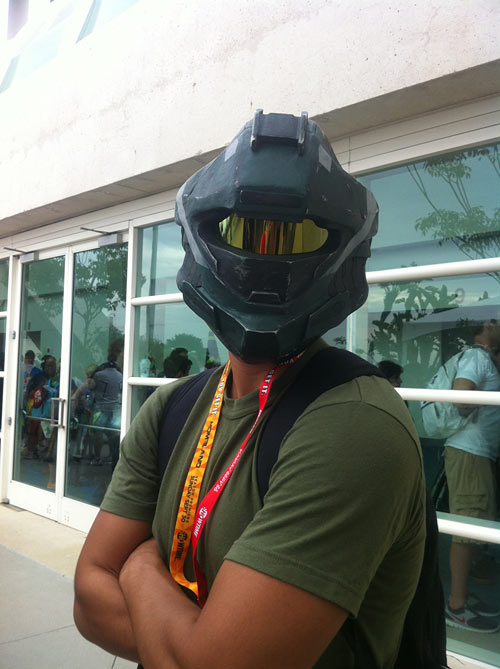 |
| He got recon |
 |
| And people say I've got a big head |
Copyright Gears of Halo.


