UNSC Infinity vs Forward Unto Dawn: Halo 4’s Two Very Different Warships
It is not a pissing contest, but yes, one spaceship is very clearly bigger than the other.
The comparison between the UNSC Infinity and the UNSC Forward Unto Dawn is one of those lovely Halo 4 lore moments where scale tells the story before the numbers even arrive. The Forward Unto Dawn is a veteran frigate, battered by the end of the Human-Covenant War and famous because it carried Master Chief and Cortana into legend. The Infinity is something else entirely: a post-war supercarrier, a symbol of human ambition, and for a while, the most intimidating thing the UNSC had ever put into the dark.
The old Halo Waypoint comparison made the point visually. Infinity is not just larger than the Forward Unto Dawn. It makes the Dawn look like a brave little knife next to a floating city with engines.

Why This Comparison Matters
The Forward Unto Dawn and the Infinity are not just two ships with different dimensions. They represent two different eras of Halo.
The Dawn belongs to the end of Halo 3. It is the ship of sacrifice, escape, and unfinished business. It fought through the portal at Voi, helped bring the Human-Covenant War to its final act, and was torn apart during the collapse of the slipspace portal. The front half made it back to Earth. The aft section, carrying Master Chief and Cortana, drifted into unknown space.
The Infinity belongs to Halo 4’s new age. It is the UNSC after survival. Bigger. Sharper. More technologically ambitious. Built during wartime, then repositioned as an exploration and research platform after the war, it becomes the vessel pulled into Requiem and tied directly to the Master Chief’s return.
Lore note: The Forward Unto Dawn is remembered because it carried the Chief into myth. Infinity is remembered because it tried to drag humanity into the Forerunner age, and discovered that being the biggest human ship in the galaxy does not make you the biggest thing in the room.
UNSC Infinity: Humanity’s Biggest Post-War Statement
The UNSC Infinity was not designed to be humble. It was built as a next-generation warship, a mobile command centre, a carrier, a research platform, and a political statement rolled into one massive hull.
Halo 4 uses Infinity brilliantly because it lets the player feel the new scale of the post-war UNSC. This is no longer the desperate, cornered humanity of Halo: Combat Evolved or Halo 2. The UNSC has survived. It has learned. It has studied Covenant and Forerunner technology. It has built something enormous.
Then Requiem reaches out and humbles it.
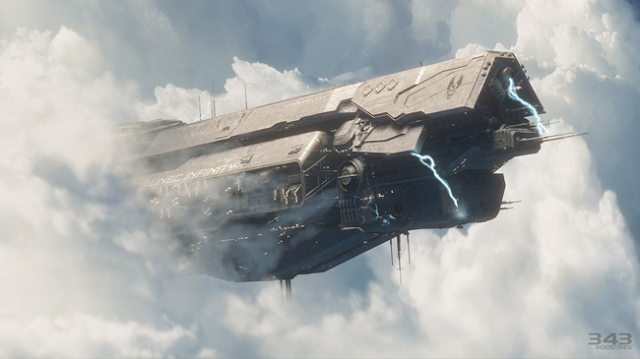
UNSC Infinity Ship Stats
The original Waypoint breakdown gave the Infinity the kind of technical profile Halo fans love: dense, military-flavoured, and just plausible enough to make the imaginary hardware feel expensive.
UNSC Infinity
Class: Infinity
Registry: INF-101
Sublight Configuration: XR2 Boglin Fields: S81/X-DFR Deuterium Fusion Reactor
Translight Configuration: Mark X Macedon/Z-PROTOTYPE #78720HDS Remote Carriage
Primary Armament: CR-08, Series-8 MAC, 4 guns
Secondary Armament: M42 Archer, 350 pods x 24 missiles
Tertiary Armament: M75 Rapier, 250 pods x 30 missiles
Quaternary Armament: M96 Howler, 500 pods x 20 missiles
Quinary Armament: M965 Fortress 70mm Point Defense Network, 830 guns
That list is pure Halo military sci-fi candy. MAC guns. Archer pods. Point defense networks. Fusion reactors. Prototype slipspace technology. The sort of thing that makes you nod as though you understand all of it, when really the important translation is simple: this thing is armed to an obscene degree.
Infinity was originally created to contend with the Covenant and other existential threats, but the post-war UNSC tried to turn it into something broader: exploration platform, research vessel, carrier, flagship, and symbol of human recovery. Then it discovered Requiem and became part of a much older Forerunner story.
Forward Unto Dawn: The Little Frigate That Carried a Legend
The UNSC Forward Unto Dawn does not win this comparison on size, weapons, or technological ambition. It wins on myth.
This is the vessel associated with the end of Halo 3, the Ark, the final stand against the Covenant, and the quiet image of Master Chief stepping into cryosleep while Cortana waits with him in the dark. The Dawn is not Halo’s biggest ship. It is one of its most emotionally loaded.

UNSC Forward Unto Dawn Ship Stats
UNSC Forward Unto Dawn
Class: Charon-class light frigate
Registry: FFG-201
Sublight Configuration: Naoto Technologies: V4/L-DFR Deuterium Fusion Reactor
Translight Configuration: Series IV CODEN/SFTE, Main
Primary Armament: Mark II, Light Coil, 83B6R3/MAC Magnetic Accelerator Cannon
Secondary Armament: M58 Archer Missile Delivery System, 50 pods
Tertiary Armament: M870 Rampart 50mm Point Defense Guns, 4 guns
Quaternary Armament: M4093 Hyperion Nuclear Delivery System, 3 silos
On paper, the Dawn is much smaller and less terrifying than Infinity. But in story terms, it carries more emotional weight than almost any UNSC vessel. It is tied to Miranda Keyes, the Arbiter, the Ark, the end of the Covenant War, and the lonely years between Halo 3 and Halo 4.
The ship’s role in the battle through the Forerunner portal at Voi places it right at the hinge point of Halo’s original trilogy. This is where the war ends, but the mystery does not. The Dawn becomes the vehicle that carries Chief and Cortana from the Bungie era into the 343 Industries era.
Hindsight note: The Forward Unto Dawn matters because it is a transition object. It ends Halo 3, bridges the gap to Halo 4, and turns Master Chief’s survival into a ghost story drifting through uncharted space.
The Real Difference: Scale vs Story
If this were only a hardware comparison, Infinity wins before the first paragraph is over. It is larger, more heavily armed, and more advanced. It represents a UNSC that has survived long enough to start thinking like a galactic power.
But Halo has never worked only because of bigger ships and bigger guns. It works because scale is constantly measured against loneliness. A ringworld is huge, but the story comes down to one soldier, one AI, and one impossible mission. Infinity is huge, but Halo 4’s emotional core still sits with Chief and Cortana inside the wreckage of everything they survived.
That is why the comparison is fun. Infinity is the future of the UNSC. Forward Unto Dawn is the memory of the war that made that future possible.
The 2026 Hindsight View
Looking back now, Infinity’s introduction in Halo 4 feels even more loaded. At the time, it looked like the UNSC had finally entered a new age of power. By Halo Infinite, that confidence had been brutally tested. Infinity’s deployment to Zeta Halo and the Banished ambush turned the flagship from a symbol of supremacy into another wreck in Halo’s long history of humbled empires.
That later fate makes the original comparison sharper. The Forward Unto Dawn looked small beside Infinity, but it completed its most important mission. It got Chief and Cortana to the next chapter. Infinity was larger, stronger, and more advanced, but Halo eventually reminded us that no ship is too big to fall.
That is very Halo. Humanity builds something enormous. The universe answers with something older, stranger, and much less impressed.
Final Thought
The Infinity versus Forward Unto Dawn comparison works because it is not really about length, tonnage, or missile pods. It is about two different kinds of importance.
Infinity is spectacle. Forward Unto Dawn is legacy.
Infinity is the post-war UNSC trying to stand tall. Forward Unto Dawn is the battered frigate that carried the Master Chief and Cortana out of one era and into the next.
One ship is bigger. The other has the better ending.
Just be glad you are not a blade runner. Different franchise, same basic lesson: the future is usually bigger, colder, and worse for your mental health than advertised.


