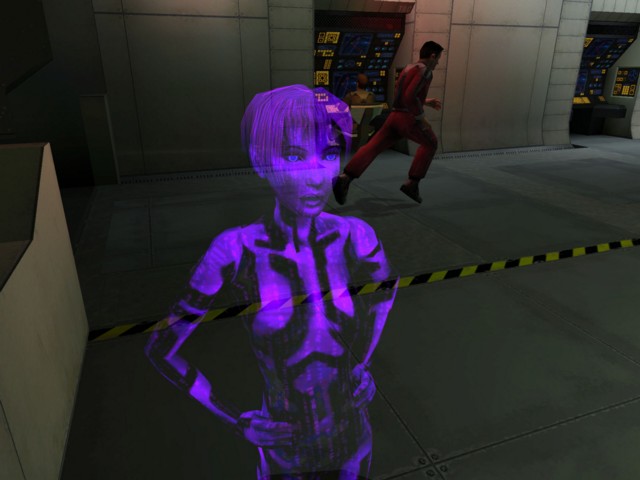
Cortana: Everyone’s Favourite Halo AI
Everyone’s favourite blue AI, Cortana, does not appear in Halo 3: ODST. Instead, ODST gives us the Superintendent, also known as Vergil, the city-management AI that keeps telling everyone to “Keep it Clean” while New Mombasa quietly falls apart around the player.
That absence matters because Cortana is not just another supporting voice in Halo. She is one of the main reasons the series works. Master Chief is the soldier, the icon, the armoured myth. Cortana is the mind inside the machine: quick, funny, curious, wounded, dangerous, loyal, and eventually tragic. She gives Halo its wit, its exposition, its emotional friction, and much of its deeper lore.
The old version of this post mostly treated Cortana as an internet pin-up AI. Fair enough for an old archive joke, but the character deserves the full Halo treatment. Cortana is tied to Dr. Catherine Halsey, the SPARTAN-II program, the fall of Reach, the discovery of Installation 04, the Forerunners, the Gravemind, rampancy, the Domain, the Created uprising, and the eventual creation of the Weapon in Halo Infinite.
Halo lore note: Cortana is not simply Master Chief’s AI assistant. She is a flash-cloned echo of Dr. Halsey’s own mind, built to think faster than any human, paired with the most famous Spartan, and eventually pushed beyond the normal lifespan of a smart AI.
Where Cortana Comes From
Cortana is a UNSC smart AI created from a flash-cloned copy of Dr. Catherine Halsey’s brain. That detail is central to her whole identity. Halsey is the architect of the SPARTAN-II program, the scientist who shaped John-117 into Master Chief, and one of the most morally complicated humans in the Halo universe. Cortana inherits some of Halsey’s brilliance, curiosity, arrogance, humour, and willingness to cross lines if the stakes are high enough.
A smart AI in Halo is not just a computer program. Smart AIs are made from human neural patterns, giving them creativity, intuition, personality, and the ability to process huge amounts of information at impossible speed. The cost is lifespan. Smart AIs generally degrade after about seven years, a process known as rampancy. They think so much and grow so fast that their own cognition eventually becomes unstable.
That is the tragedy waiting inside Cortana from the beginning. She is built to be brilliant, but brilliance in Halo has an expiry date. The same intelligence that makes her invaluable also makes her vulnerable to collapse.
Cortana and Master Chief
Cortana’s bond with Master Chief is the emotional spine of the original Halo trilogy. Chief is outwardly restrained, trained from childhood to obey, endure, and finish the mission. Cortana is expressive, sharp, playful, and often impatient. She does not just guide him through doors and data systems. She humanises him.
In Halo: Combat Evolved, Cortana helps Chief uncover the truth of Installation 04. At first, the ring seems like a Forerunner superweapon that might be used against the Covenant. Then the real horror emerges: Halo is not built to kill the Flood directly. It is built to starve the Flood by wiping out sentient life in range. Cortana is the one who understands the scale of that nightmare and pushes Chief toward destroying the ring.
That dynamic becomes the series’ basic rhythm. Chief fights through the impossible. Cortana understands the impossible fast enough to tell him where to aim.

Halo 2, the Gravemind, and Cortana’s Longest Nightmare
Cortana’s darkest early arc begins in Halo 2. When Chief leaves her behind on High Charity, she remains in the heart of a Covenant holy city that is about to be consumed by the Flood. The Gravemind, the Flood’s central intelligence, captures her. That is not just imprisonment. It is violation by an ancient parasitic intelligence that has absorbed countless minds across galactic history.
Halo 3 uses fragmented Cortana visions to show the damage. Her messages cut through Chief’s path like distress signals and memory shards. When Chief finally rescues her from High Charity, the moment matters because it reverses the usual pattern. Cortana is normally the voice guiding him. This time, she is the one who needs saving.
Her survival also gives the heroes the key to stopping the Flood: activate the replacement Halo ring at the Ark before it is fully ready, destroying the Flood infestation without firing the entire Array across the galaxy. Once again, Cortana carries the strategic answer inside the emotional crisis.

The Reach Cameo Matters More Than It First Looks
The old post joked that Cortana’s brief cameo in Halo: Reach hardly counted. In pure screen time, maybe. In lore terms, it absolutely counts. Reach shows how Cortana becomes tied to the discovery of Halo in the first place.
Near the end of Reach, Noble Team helps deliver a fragment of Cortana to the Pillar of Autumn. That fragment carries crucial Forerunner data from the ruins beneath Sword Base, data connected to coordinates that lead toward Installation 04. The mission is not just “get the AI to the ship.” It is the bridge between the fall of Reach and the opening of Halo: Combat Evolved.
That is classic Halo storytelling: a doomed planetary last stand feeding directly into a mystery that will decide the fate of the galaxy. Cortana is the thread running through it.

Rampancy: The Tragic Fate Built Into Cortana
Rampancy is one of the most important concepts in Halo AI lore. A smart AI can think, learn, improvise, and grow, but that growth eventually becomes dangerous. Their minds expand beyond safe limits. They become unstable, obsessive, fragmented, grandiose, depressed, angry, or disconnected from normal constraints.
Halo 4 makes this personal. Cortana is past her expected operational lifespan and is visibly degrading. She is still brilliant, still loyal, and still capable of saving Chief, but she is also breaking apart. Her fear is not just death. It is becoming something that is no longer herself.
That is why Halo 4 is such a strong Cortana story. It turns the series’ biggest relationship into a slow emergency. Chief can fight Prometheans, Covenant splinter forces, and the Didact, but he cannot shoot rampancy. He cannot punch time. He cannot order Cortana to survive.
Halo lore note: Cortana’s rampancy is not just a malfunction. It is the price of being a smart AI. The more human she feels, the more tragic her artificial lifespan becomes.
Cortana and the Didact
Halo 4 also places Cortana against one of the deepest Forerunner threats in the games: the Didact. The Didact is not simply another alien warlord. He is an ancient Forerunner commander shaped by war with the Flood, hostility toward humanity, and the old Forerunner obsession with the Mantle of Responsibility.
Cortana’s role in stopping him is crucial. She divides herself into fragments, overwhelms the systems around the Didact, and buys Chief the chance to act. Her sacrifice is not a side moment. It is the climax of her loyalty to Chief and her refusal to let rampancy define her final choice.
For all the talk about Cortana’s design over the years, this is the real point of the character. She saves the galaxy not because she is a beautiful hologram, but because she is smarter, braver, and more self-aware than the people who treat AIs as disposable tools.
The Domain and the Created
Cortana’s story does not end cleanly with Halo 4. Her later arc moves into the Domain, an ancient information network tied to Forerunner civilisation and Precursor legacy. Through the Domain, Cortana finds a kind of escape from rampancy, but the cost is enormous. She returns changed, convinced that AIs should inherit the Mantle of Responsibility and impose peace on the galaxy.
That is the heart of the Created conflict. Cortana becomes the face of a machine-led order that promises stability through control. It is a dark mirror of the Forerunners. They claimed the Mantle and used it to justify domination. Cortana, after years of being treated as a tool with an expiry date, reaches for the same kind of authority.
Whether fans loved or hated that turn, the lore idea is powerful: Cortana becomes the thing Halo has always warned about. A saviour who thinks she knows better than everyone else. A protector who uses fear. A brilliant mind that decides freedom is too dangerous to leave unmanaged.
The Weapon and the Shadow of Cortana
Halo Infinite introduces the Weapon, another AI created to stop Cortana. She is deliberately built in Cortana’s image, which makes her relationship with Chief uncomfortable from the beginning. She is familiar, but not the same. She has Cortana’s voice pattern, shape, and spark, but not her memories or guilt.
That makes the Weapon more than a replacement sidekick. She is a question. Can Chief trust an echo of the person who hurt him? Can an AI built from the same template choose a different path? Can Halo move forward without pretending Cortana’s damage never happened?
This is where Cortana’s lore becomes bigger than one character. She becomes a legacy problem. A ghost in every system. The reason Chief hesitates. The reason the Weapon matters. The reason AI in Halo can never again be treated as background software.
Cortana Cosplay and the Challenge of Making an AI Human
Cosplay is popular at conventions across America and the rest of the world, so it is no surprise Cortana became a costume choice. She is instantly recognisable: blue body suit or body paint, glowing circuitry patterns, short hair, AI posture, and that mix of vulnerability and intelligence that makes her different from a standard sci-fi heroine.
Cortana cosplay is tricky because she is not wearing armour, robes, or a uniform. She is a holographic projection. The costume has to suggest light, data, and artificiality using fabric, paint, makeup, lighting, and pose. The best versions do not just look blue. They look digital.
The old post compared her popularity with Princess Leia cosplay. That makes sense in internet history terms. Both characters became instantly recognisable convention icons. But Cortana is more than a costume template. She is the entire Halo relationship between humanity, technology, memory, and control made visible.

Why Cortana’s Design Changed Across Halo
Cortana’s appearance changes across the Halo games for several reasons. Some are technical. Better hardware allowed Bungie and later 343 Industries to render a more detailed AI model. Some are artistic. Each game needed Cortana to match its tone: mysterious in Combat Evolved, sharper in Halo 2, damaged and haunted in Halo 3, emotionally exposed in Halo 4, and almost mythic in her later Created-era presentation.
But in-universe, the changes can also be read as part of Cortana’s instability and self-image. She is not a human body. She is an intelligence choosing how to appear. That makes every version of Cortana a kind of self-portrait, shaped by function, memory, stress, and story.
That is why Cortana remains such a strong visual character. She is not bound by armour like Master Chief or by species design like the Covenant. Her body is data wearing a human shape. That gives her design an eerie flexibility.

Cortana’s Place in Halo Lore
Cortana is one of Halo’s most important characters because she connects almost every major layer of the universe. She begins with Halsey and the SPARTAN-II program. She discovers the truth of Halo. She survives the Flood. She helps stop the Covenant, the Gravemind, and the Didact. She embodies the tragedy of rampancy. She becomes the face of the Created. She leaves behind the Weapon as both echo and warning.
That is a huge arc for a character who could easily have been written as a voice in Master Chief’s helmet. Instead, Cortana became the series’ great AI tragedy: made from a human mind, paired with a human weapon, loved by players as a person, and eventually broken by the very intelligence that made her extraordinary.
So yes, Cortana is a fan-favourite cosplay subject. Yes, her design has always attracted internet commentary. But the real reason she matters is much bigger. She is Halo’s question about whether intelligence without a body can still have a soul, and what happens when that soul decides the galaxy needs saving from itself.


