Who are The Reapers in Mass Effect?

What Are the Reapers in Mass Effect?

The Reapers are the great nightmare at the heart of Mass Effect: ancient synthetic-organic starships that return every 50,000 years to harvest advanced civilisation. They are not merely big enemy ships. They are the hidden architecture of galactic history, the reason the mass relay network exists, the trap behind the Citadel, and the force that turns progress itself into bait.

Every cycle, organic species rise. They discover mass effect technology. They expand through the relay network. They gather at the Citadel. They believe they are building their own future. Then the Reapers return from dark space and cut the head off galactic civilisation in one surgical strike.

That is what makes them more frightening than ordinary video game villains. The Reapers do not simply invade. They farm history.

Human Reaper from Mass Effect 2 showing the incomplete Reaper larva built from harvested human genetic material
The Human-Reaper from Mass Effect 2 turns the Reaper threat into body horror: civilisation processed into a machine god.

The Reapers Are Not Just Machines

The word “Reaper” is not their own name. Sovereign, the first Reaper Commander Shepard truly encounters, insists that the term was given to them by the Protheans. To Sovereign, names are almost beneath the point. The Reapers simply are.

The geth know them as the Old Machines, which is a cleaner description but no more comforting. Reapers are synthetic-organic starships, each one a colossal intelligence, a war machine, and a preserved civilisation folded into a single terrible form. Legion’s description in Mass Effect 2 says it best: “One ship, one will, many minds.”

That line is doing a lot of work. A Reaper is not just a ship with a brain. It is a machine built out of harvested life. It carries the biological and cultural residue of the species used to create it, then turns that memory into another instrument of the cycle.

Lore note: The Reapers are horrifying because they do not simply destroy civilisation. They convert it. The harvest is not only genocide. It is reproduction.

Dark Space and the 50,000-Year Cycle

Between cycles, the Reapers wait in dark space, the empty region beyond the galaxy’s outer rim. They hibernate there for tens of thousands of years, outside the normal reach of galactic exploration, until the time comes to return.

The genius of their system is that the galaxy itself has been shaped to make the harvest easier. The mass relays allow young civilisations to expand quickly, but they also guide those civilisations along predictable paths. The Citadel becomes the political and logistical centre of galactic life because the Reapers designed it to be irresistible.

When the Citadel relay is activated, the Reapers are meant to return directly into the heart of galactic government. They seize the Citadel, decapitate leadership, control the relay network, isolate star systems, and then proceed methodically through the galaxy. It is not a chaotic invasion. It is an engineered extinction protocol.

The cycle has repeated for millions of years. The Protheans were not the first to fall. They were merely the previous civilisation advanced enough to understand the trap, too late to escape it.

Where Did the Reapers Come From?

Early in the trilogy, the Reapers feel unknowable. Sovereign claims they have always existed and have no creators. That is part intimidation, part arrogance, and part cosmic horror theatre. The later Leviathan material gives the origin a sharper shape.

Before the current galactic order, the Leviathans dominated the galaxy and watched organic civilisations repeatedly create synthetic life that eventually turned against them. To solve this, they created an intelligence known as the Catalyst, designed to preserve life and resolve the conflict between organics and synthetics.

The Catalyst reached a monstrous conclusion: organic life should be preserved by harvesting advanced civilisations at their peak, converting them into Reapers, and resetting the galaxy before organics and synthetics destroyed each other. The first victims were the Leviathans themselves. Their image and substance became the foundation for the Reaper form.

That origin does not make the Reapers less terrifying. It makes them worse. They are not random monsters from the dark. They are a broken solution that became a religion, a machine logic that mistook preservation for annihilation.

Sovereign, Saren, and the First Mass Effect

In the first Mass Effect, Sovereign is initially treated as a massive dreadnought of unknown origin, apparently controlled by the rogue Spectre Saren Arterius. That is the trick. Sovereign is not Saren’s ship. Saren is Sovereign’s tool.

The reveal on Virmire is one of the great moments in the trilogy. Sovereign speaks to Shepard not like an enemy commander, but like a god tired of explaining itself to insects. Its language is vast, arrogant, and deliberately dehumanising. It does not threaten the galaxy in ordinary terms. It tells Shepard that extinction is inevitable because extinction has already happened countless times before.

Sovereign’s role is that of the vanguard. It was left behind to monitor the galaxy and trigger the Citadel relay when the next harvest was ready. The Protheans disrupted that plan, forcing Sovereign to work through agents such as Saren, the geth heretics, and the Citadel attack itself.

That is why the climax of Mass Effect works so well. Shepard is not simply stopping one rogue Spectre. Shepard is interrupting the Reapers’ preferred method of return.

The Prothean Counterattack

The Protheans were crushed by the Reapers, but not completely erased before they managed one decisive act of resistance. A group of elite Prothean scientists survived on Ilos and eventually discovered the connection between the Citadel, the keepers, and the Reaper signal.

The keepers were supposed to respond to the Reaper vanguard’s signal and open the Citadel relay, allowing the full Reaper fleet to arrive from dark space. The Prothean scientists used the Conduit, a prototype mass relay, to reach the Citadel and alter the signal. When Sovereign eventually called for the keepers to open the way, they did nothing.

That single act broke the normal cycle. It did not destroy the Reapers. It did not save the Protheans. But it gave the next cycle, Shepard’s cycle, a fighting chance.

Sovereign’s direct assault on the Citadel was the result of that failure. It needed Saren and the geth to manually activate what the keepers would no longer open. When Shepard stopped Saren and the combined Citadel forces destroyed Sovereign, the Reapers lost their cleanest path back into the galaxy.

Reaper fleet in Mass Effect showing the ancient machine race awakening from dark space
The Reaper fleet waiting in dark space, the nightmare Mass Effect spends three games dragging into the light.

The Human-Reaper and the Collectors

Mass Effect 2 shifts the Reaper threat from cosmic dread into body horror. The Collectors begin abducting human colonies from the Terminus Systems, and the reason is worse than simple extermination. The abducted humans are being processed into raw genetic material to construct a new Reaper.

The Collectors themselves are another Reaper atrocity. They are not a separate mystery species in the ordinary sense. They are the genetically altered remnants of the Protheans, captured and repurposed after the last cycle. The Reapers did not merely defeat the Protheans. They turned some of them into tools.

Harbinger directs the Collectors and uses them to continue the Reaper plan after Sovereign’s destruction. The Human-Reaper larva at the Collector Base shows how the harvest functions as reproduction. Humanity, having defeated Sovereign, becomes intensely interesting to the Reapers as raw material.

When Shepard reaches the Collector Base, the incomplete Human-Reaper is already taking shape: skull, arms, ribcage, spine, machine framework, and processed human essence. EDI concludes that tens of thousands of humans have already been consumed in its construction.

That is what makes the Human-Reaper sequence so grotesque. It takes the abstract Reaper cycle and makes it physical. Colonies disappear. Bodies become paste. A civilisation is turned into a machine with a face.

With the Human-Reaper destroyed and the Collectors defeated, Harbinger and the rest of the Reaper fleet begin moving toward the Milky Way. Shepard has delayed the cycle, but not stopped it.

Character note: Legion’s “one ship, one will, many minds” line is one of the most chilling pieces of Reaper lore because it implies that harvested life does not simply vanish. It may continue inside the machine.

Indoctrination: The Reapers’ Quietest Weapon

The Reapers are terrifying as warships, but indoctrination is what makes them truly dangerous. Their technology emits signals that slowly erode organic thought, weakening independent judgement and bending victims toward Reaper goals.

Indoctrination can look subtle at first. Suggestion. Obsession. Rationalisation. Loyalty to an idea that is not really yours anymore. Over time, the victim loses autonomy and becomes another instrument of the Reaper will.

Saren is the clearest example in the first game. Sovereign does not simply puppet him from the beginning. It allows him enough free will to remain useful. Saren convinces himself that submission is a survival strategy, that organics might be spared if they prove their value. That is indoctrination at its most insidious: the victim still believes he is making arguments.

Matriarch Benezia shows another side of it. Even a powerful asari matriarch can only resist for so long. Her tragedy is that she understands what is happening to her and still cannot fully escape it.

The derelict Reaper in Mass Effect 2 makes the danger even clearer. A Reaper does not need to be fully operational to corrupt minds. Even dead or disabled Reaper technology can continue to damage organic thought. That means the Reapers do not only conquer with fleets. They contaminate reality around them.

Reaper Design: Cuttlefish, Starships, and Machine Gods

Sovereign’s design is one of Mass Effect’s smartest visual decisions. It looks like a ship, but not only a ship. The cuttlefish or squid-like silhouette gives it an organic wrongness. The long hull, jointed limbs, and weaponised tentacles make it feel like something that could crawl, swim, fly, and think all at once.

The Reaper form also separates them from normal science-fiction warships. A dreadnought can be intimidating. A Reaper feels like a predator pretending to be a vessel.

Harbinger and the wider fleet share that core language, though there are variations. Some appear more insect-like, some more cuttlefish-like, some with different limb structures and glowing eye patterns. That diversity fits the idea that each Reaper may preserve something of the species used in its creation, even if most of the capital ships still echo the Leviathan-derived form.

This visual design also explains why the heretic geth worship them. Reapers are everything the heretic geth admire: independent synthetic power, vast intelligence, and machine existence freed from organic limits. Their monuments to Sovereign’s form are not just decorations. They are religious architecture built by machines worshipping machines.

Reaper Weapons and Technology

Even without indoctrination, Reapers are almost impossibly dangerous warships. Sovereign’s weapons can tear through cruisers and dreadnoughts. Their main guns fire streams of molten metal at a fraction of light speed, shredding kinetic barriers and hull plating with brutal efficiency.

Reapers are also protected by advanced kinetic barriers, massive armour, and the simple advantage of scale. A single Reaper can devastate fleets. A Reaper invasion can overwhelm planets.

But they are not invincible. Sovereign is destroyed after its defences are compromised during the Battle of the Citadel. Reaper destroyers can be brought down with enough firepower, especially under the right battlefield conditions. The entire trilogy depends on the difference between “nearly unstoppable” and “actually impossible.”

That narrow gap is where Shepard lives.

The Reaper War and Earth

By Mass Effect 3, the waiting is over. The Reapers arrive in force and Earth becomes one of the first great symbols of the invasion. This is no longer a mystery handled through visions, warnings, and isolated encounters. The harvest has begun openly.

The invasion of Earth works because it turns galactic horror into something immediate. Skyscrapers burn. Fleets collapse. Civilians run. Reaper silhouettes dominate the skyline. The trilogy’s abstract extinction cycle becomes a city-level nightmare.

The Reapers do what they have always done: overwhelm command structures, isolate systems, turn populations into resources, and use indoctrinated agents to weaken resistance from within. The only difference is that this cycle has Shepard, the Crucible project, and a galaxy that has at least begun to understand what it is fighting.

Mass Effect 3 London skyline during the Reaper invasion of Earth
Mass Effect 3 brings the Reaper threat home, turning Earth’s skyline into the front line of a galactic extinction event.

Why the Reapers Work as Villains

The Reapers work because they combine several kinds of fear at once. They are cosmic horror, because they are ancient and almost beyond comprehension. They are machine horror, because they reduce life to pattern, resource, and function. They are religious horror, because their language is full of inevitability, judgment, and godlike superiority. They are body horror, because the harvest turns living beings into material.

They also make the Mass Effect universe feel rigged. The relays, the Citadel, galactic politics, technological development, even the shape of progress itself, all of it has been influenced by the Reapers. Civilisation believes it is climbing upward, when in fact it is being guided into a slaughterhouse with better lighting.

That is why Sovereign’s conversation on Virmire still matters. It is not simply a villain monologue. It is the moment Mass Effect tells the player that the galaxy is older, darker, and more manipulated than anyone understood.

The Reapers are not frightening because they are impossible to kill. They are frightening because they built the road everyone else was walking on.

Read Article →

It's not a pissing contest but my space ship is bigger than yours

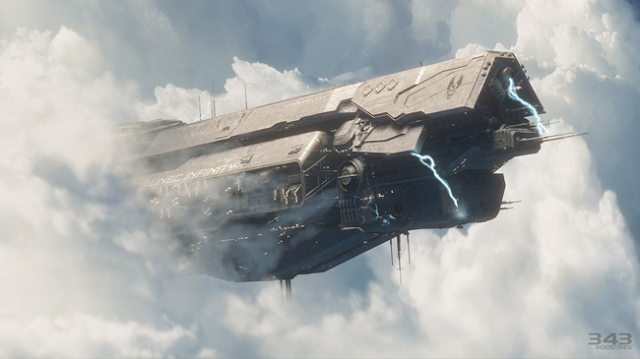
UNSC Infinity vs Forward Unto Dawn: Halo 4’s Two Very Different Warships

It is not a pissing contest, but yes, one spaceship is very clearly bigger than the other.

The comparison between the UNSC Infinity and the UNSC Forward Unto Dawn is one of those lovely Halo 4 lore moments where scale tells the story before the numbers even arrive. The Forward Unto Dawn is a veteran frigate, battered by the end of the Human-Covenant War and famous because it carried Master Chief and Cortana into legend. The Infinity is something else entirely: a post-war supercarrier, a symbol of human ambition, and for a while, the most intimidating thing the UNSC had ever put into the dark.

The old Halo Waypoint comparison made the point visually. Infinity is not just larger than the Forward Unto Dawn. It makes the Dawn look like a brave little knife next to a floating city with engines.

UNSC Infinity compared with Forward Unto Dawn in Halo 4 showing the huge size difference between the two Halo ships
The UNSC Infinity beside the Forward Unto Dawn. One is a battle-scarred frigate from the old war. The other is humanity’s post-war flex in ship form.

Why This Comparison Matters

The Forward Unto Dawn and the Infinity are not just two ships with different dimensions. They represent two different eras of Halo.

The Dawn belongs to the end of Halo 3. It is the ship of sacrifice, escape, and unfinished business. It fought through the portal at Voi, helped bring the Human-Covenant War to its final act, and was torn apart during the collapse of the slipspace portal. The front half made it back to Earth. The aft section, carrying Master Chief and Cortana, drifted into unknown space.

The Infinity belongs to Halo 4’s new age. It is the UNSC after survival. Bigger. Sharper. More technologically ambitious. Built during wartime, then repositioned as an exploration and research platform after the war, it becomes the vessel pulled into Requiem and tied directly to the Master Chief’s return.

Lore note: The Forward Unto Dawn is remembered because it carried the Chief into myth. Infinity is remembered because it tried to drag humanity into the Forerunner age, and discovered that being the biggest human ship in the galaxy does not make you the biggest thing in the room.

UNSC Infinity: Humanity’s Biggest Post-War Statement

The UNSC Infinity was not designed to be humble. It was built as a next-generation warship, a mobile command centre, a carrier, a research platform, and a political statement rolled into one massive hull.

Halo 4 uses Infinity brilliantly because it lets the player feel the new scale of the post-war UNSC. This is no longer the desperate, cornered humanity of Halo: Combat Evolved or Halo 2. The UNSC has survived. It has learned. It has studied Covenant and Forerunner technology. It has built something enormous.

Then Requiem reaches out and humbles it.

UNSC Infinity in Halo 4 after being drawn toward the Forerunner shield world Requiem
Infinity arrives in Halo 4 like the future of the UNSC, then immediately gets caught in forces older and stranger than human engineering can fully understand.

UNSC Infinity Ship Stats

The original Waypoint breakdown gave the Infinity the kind of technical profile Halo fans love: dense, military-flavoured, and just plausible enough to make the imaginary hardware feel expensive.

UNSC Infinity

Class: Infinity

Registry: INF-101

Sublight Configuration: XR2 Boglin Fields: S81/X-DFR Deuterium Fusion Reactor

Translight Configuration: Mark X Macedon/Z-PROTOTYPE #78720HDS Remote Carriage

Primary Armament: CR-08, Series-8 MAC, 4 guns

Secondary Armament: M42 Archer, 350 pods x 24 missiles

Tertiary Armament: M75 Rapier, 250 pods x 30 missiles

Quaternary Armament: M96 Howler, 500 pods x 20 missiles

Quinary Armament: M965 Fortress 70mm Point Defense Network, 830 guns

That list is pure Halo military sci-fi candy. MAC guns. Archer pods. Point defense networks. Fusion reactors. Prototype slipspace technology. The sort of thing that makes you nod as though you understand all of it, when really the important translation is simple: this thing is armed to an obscene degree.

Infinity was originally created to contend with the Covenant and other existential threats, but the post-war UNSC tried to turn it into something broader: exploration platform, research vessel, carrier, flagship, and symbol of human recovery. Then it discovered Requiem and became part of a much older Forerunner story.

Forward Unto Dawn: The Little Frigate That Carried a Legend

The UNSC Forward Unto Dawn does not win this comparison on size, weapons, or technological ambition. It wins on myth.

This is the vessel associated with the end of Halo 3, the Ark, the final stand against the Covenant, and the quiet image of Master Chief stepping into cryosleep while Cortana waits with him in the dark. The Dawn is not Halo’s biggest ship. It is one of its most emotionally loaded.

UNSC Forward Unto Dawn frigate from Halo 3 and Halo 4 carrying Master Chief and Cortana after the Human-Covenant War
The Forward Unto Dawn, a Charon-class light frigate made famous by Halo 3’s ending and Master Chief’s long drift toward Requiem.

UNSC Forward Unto Dawn Ship Stats

UNSC Forward Unto Dawn

Class: Charon-class light frigate

Registry: FFG-201

Sublight Configuration: Naoto Technologies: V4/L-DFR Deuterium Fusion Reactor

Translight Configuration: Series IV CODEN/SFTE, Main

Primary Armament: Mark II, Light Coil, 83B6R3/MAC Magnetic Accelerator Cannon

Secondary Armament: M58 Archer Missile Delivery System, 50 pods

Tertiary Armament: M870 Rampart 50mm Point Defense Guns, 4 guns

Quaternary Armament: M4093 Hyperion Nuclear Delivery System, 3 silos

On paper, the Dawn is much smaller and less terrifying than Infinity. But in story terms, it carries more emotional weight than almost any UNSC vessel. It is tied to Miranda Keyes, the Arbiter, the Ark, the end of the Covenant War, and the lonely years between Halo 3 and Halo 4.

The ship’s role in the battle through the Forerunner portal at Voi places it right at the hinge point of Halo’s original trilogy. This is where the war ends, but the mystery does not. The Dawn becomes the vehicle that carries Chief and Cortana from the Bungie era into the 343 Industries era.

Hindsight note: The Forward Unto Dawn matters because it is a transition object. It ends Halo 3, bridges the gap to Halo 4, and turns Master Chief’s survival into a ghost story drifting through uncharted space.

The Real Difference: Scale vs Story

If this were only a hardware comparison, Infinity wins before the first paragraph is over. It is larger, more heavily armed, and more advanced. It represents a UNSC that has survived long enough to start thinking like a galactic power.

But Halo has never worked only because of bigger ships and bigger guns. It works because scale is constantly measured against loneliness. A ringworld is huge, but the story comes down to one soldier, one AI, and one impossible mission. Infinity is huge, but Halo 4’s emotional core still sits with Chief and Cortana inside the wreckage of everything they survived.

That is why the comparison is fun. Infinity is the future of the UNSC. Forward Unto Dawn is the memory of the war that made that future possible.

The 2026 Hindsight View

Looking back now, Infinity’s introduction in Halo 4 feels even more loaded. At the time, it looked like the UNSC had finally entered a new age of power. By Halo Infinite, that confidence had been brutally tested. Infinity’s deployment to Zeta Halo and the Banished ambush turned the flagship from a symbol of supremacy into another wreck in Halo’s long history of humbled empires.

That later fate makes the original comparison sharper. The Forward Unto Dawn looked small beside Infinity, but it completed its most important mission. It got Chief and Cortana to the next chapter. Infinity was larger, stronger, and more advanced, but Halo eventually reminded us that no ship is too big to fall.

That is very Halo. Humanity builds something enormous. The universe answers with something older, stranger, and much less impressed.

Final Thought

The Infinity versus Forward Unto Dawn comparison works because it is not really about length, tonnage, or missile pods. It is about two different kinds of importance.

Infinity is spectacle. Forward Unto Dawn is legacy.

Infinity is the post-war UNSC trying to stand tall. Forward Unto Dawn is the battered frigate that carried the Master Chief and Cortana out of one era and into the next.

One ship is bigger. The other has the better ending.

Just be glad you are not a blade runner. Different franchise, same basic lesson: the future is usually bigger, colder, and worse for your mental health than advertised.

Read Article →

A brief history of Halo: The Story Explained


The story of Halo is no fairy tale set in a Castle that needs protection from a marauding dragon. It is, however, a monster of a tale spanning the length of the universe from Earth to places with strange names like Onyx. Many fans might know Halo only through the Xbox games, others may have expanded their knowledge from reading the books, graphic novels and the Halo Encyclopedia. Halo Waypoint has handily put together a brief history of Halo for anyone who might just be a little curious about what’s actually going on as sometimes even in the games it’s not clear!

The Halo Story Explained

Long before humanity shed its own earthly shackles, an ancient race known as the Forerunners had already mastered control of the heavens. Using their technology they took it upon themselves to protect all life in the galaxy. But when a dark threat emerged from the blackness beyond the galaxy’s stars, the Forerunners surprisingly were caught off guard.

The Flood, a parasitic alien species that propagates itself by infecting sentient beings, had already infested a variety of worlds within the Milky Way galaxy. By the time the Forerunners took action against the Flood, it was too late; the Flood had already surpassed any efforts at containment offered.

Fearing all in the galaxy would be lost forever to the Flood, a group of Forerunners developed a plan to stop the parasite once and for all. They called this plan Halo. Using a massive installation known as the Ark, they built seven ring worlds, which they spread throughout the galaxy as a defensive mechanism. This Halo Array, as they called it, when fired, would destroy all sentient beings within range, effectively starving the Flood to death as there would be nothing left for it to use to spread.

Then, after staying the hand of judgment as long as they could, the Forerunners finally fired the rings and seemingly vanished from existence to never be heard of again. The knowledge surrounding the Halo Array and its use and as well as the Ark was lost for a time. All that remained was the hope that someone, somewhere in the distant future, would discover the truth.

One hundred thousand years later, humankind finally turned its eyes to the stars. But even after developing the technology of Slipspace travel, which allowed them to colonize distant worlds, they failed to learn from their own primitive nature, they went too far, too quick.

Not long after humans built other worlds to inhabit, they began to war with each other. A powerful governing body known as the United Nations Space Command (UNSC) attempted to quell any insurrectionist factions, but there seemed to be nothing that could halt the mounting tide of violence between mankind.
It was then that an agency known as the Office of Naval Intelligence (ONI) commissioned the SPARTAN-II project. This extreme measure sanctioned the abduction of young children who would be genetically engineered into the most advanced supersoldiers humanity had ever seen. And for a time, this solution worked flawlessly, the Spartans meted out swift, almost merciless, judgment against any who resisted the orders of  United Nations Space Command.

But in 2525 CE, all of that changed.

Without warning, the Outer Colony of Harvest was obliterated by an unknown force, a force that would later reveal itself as the Covenant. This alliance of alien species believed humanity was a stain that needed to be wiped from the galaxy, and they committed themselves to this belief without any mercy and proved ruthless in doing so.

Extinguishing every human population they could find, the Covenant were consumed with humankind's total and complete annihilation. However, despite being greatly outnumbered, the Spartans engaged the alien enemy in groundside conflicts, frustrating the Covenant’s advancement every step of the way. Ultimately, each terrestrial victory proved insignificant, since the Covenant dominated space battles without contest.

Still, it wasn't until they attacked the planet of Reach, Earth's veritable doorstep on the brink of humanity’s extinction, that these legendary Spartans fell.

Fleeing into Slipspace at a seemingly random vector, a UNSC warship brought with it what was believed to be the last remaining Spartan, the enigmatic Master Chief, John 117. As they arrived in a remote, uncharted region of the galaxy, they suddenly came face to face with something they had never before seen —Halo.
Read Article →

The Space Ships of Halo: Reach

Long Night of Solace

The Long Night of Solace was the Covenant super carrier that destroyed the UNSC Grafton in the Halo Reach game and destroyed  several other UNSC deployments. 
Grafton
Pillar of Autumn

The above Pillar of Autumn was where Halo really first began - as the Master Chief you were woken to fight the Coveant who had found you - so in the context of Reach, the Pillar escapes with Noble 6's help, to which then the Master Chief takes over the protection of Cortana

Ardent Prayer


The Ardent Prayer was used as part of the plan to destroy the Supercarrier, Long Night of Solace. You may not know that Ardent Prayer is the setting of the Halo: Reach multiplayer map Zealot, and the Firefight map Corvette.

The Space Ships of Halo: Reach (The below was all speculation before the Reach game was released)


You can't have an epic space battle between two different races without one at least having got to the battle in a space ship. Where the Fall of Reach is concerned, the allied forces of the Covenant had a massive armada of ships and the humans had a few too, with perhaps the Pillar of Autumn being the most famous.


So what are the human ships that might be found in the game of Halo: Reach? Here's some of the contenders:


Three UNSC ships, the destroyer Heracles and the frigates Arabia and the Vostok, were sent to investigate the destruction of the Harvest colony by Covenant forces. Only the Heracles survived the subsequent encounter with the Covenent and made it back to the planet Reach.


During the battle of Reach most of the UNSC space ships in the area were destroyed. Some confirmed KIA, others MIA. The Herodotus was a UNSC Destroyer that notably got carved up by an Energy Projector. The projector is a laser that the Covenant used to glass Reach and many other places including a bit of Earth in the game Halo 3 to prevent the spread of the Flood. 


Other vessels to fall to the Covenant included the Musashi, the Minotaur and the Tharsis. The Frigate Euphrates also was KIA and the Applebee and the Lark also got pwned. They all might rate a mention in the game.


The Longsword Starfighter bomber Knife 26 was also used:


Longsword
During Reach, a Longsword was used by Lieutenant Keyes destroyed a Covenant Supercruiser. The Longsword delivered a Nuclear Warhead to the ship - it was was an unmanned sortie flight controlled by remote piloting.

During the Fall of Reach, Keyes is in command of the ship Iroquois, in which he showed gallantry in destroying 4 Covenant vessels. This is perhaps ironic given Keyes was unwittingly responsible for the Covenant finding Reach as the Iroquois was tagged by a Covenant Spy Probe which gave them the planet's positioning.

Given this ship had a fairly prominent role in the space battle over Reach, it is possible that Iroquois will be mentioned in the Halo: Reach xbox game - it all depends on the timing of the ground mission of the Spartans as it's understood the game is focussed largely on the ground.

Given the sad fact that the Pillar of Autumn is the only known UNSC space ship to have survived the reach episode, and all other being presumed to have been destroyed (stated in Halo: CE, I think?) the fate of the Iroquois is that it is presumed to have been destroyed as well.


Pillar of Autumn

So the Pillar of Autumn is probably the only space ship that we can pretty much guarantee will be in the Halo: Reach game as it was the ship that found the Halo installation after Keyes followed the Cole Protocol and its the ship the the Master Chief eventually ended up on. In the original Halo: CE, you start and end the game in the space ship - so it must surely be going to feature!

Extra for Experts: Aegis Fate

One keen Halo fan has made a Lego version of the Aegis Fate which although having a larger role in the time frame of the Halo 3 game, during Reach it was on duty protecting Earth.


Aegis Fate made of Lego

Read Article →

Search

↑ Top